1st Day: to Delhi
First impressions of India. Everything seems to be in a state of flux: new buildings, half complete; roads half built; old buildings decaying or half demolished. Cows wandering suburban Delhi streets. Camels pulling heavily laden carts. Whole families – father, mother, children, goat – on mopeds. Endless lines of trucks moving laboriously sounding their musical horns almost continuously, broken down, being repaired or taken apart. Men on bicycles pulling heavily laden carts. A young man, body cruelly twisted, dragging himself along by means of a long pole, like those used to propel a punt. Dust and heat. The roadside full of tiny sheds, repair shops, food stalls, bits of machinery, tyres, rubble and rubbish.
The Indira Gandhi Airport was rebuilt for the Commonwealth Games and as a result it is clean, efficient and friendly. Our declaration of dairy products was met with amused indifference by a trio of languorous policemen. Our initial impressions of our hotel, on reaching it after a tortuous drive through side streets and road works, proved to be less than favourable, an impression possibly exacerbated by our travel driven fatigue. Our first, rather shabby room was found to have no operating air-conditioning, so we were reluctantly moved to a room that, while the air-conditioning, though noisy, did work after a fashion, contained no windows. Not a propitious start to our adventure.
2nd Day: Jaipur
Last evening, after arriving at our quite commodious accommodation, we ventured out, guided by our travel guide to a close-by vegetarian restaurant, which promised good food and cold beer. After a vain and aimless wander in search of the said restaurant, and several conversations with passers-by seeking directions, we clambered into a tuk-tuk driven by someone who it transpired had absolutely no idea where we were going- rather like Dirk Gently but without the serendipity. As we headed further and further away from what we thought to be our desired location, we stopped yet another passer-by, and as a result of his guidance finally found the sought-after restaurant only to discover to our chagrin that our guidebook was in error, as the restaurant did not serve alcohol, or indeed permit it on the premises. By this time, we were hot, thirsty and hungry, but having been given directions to a licensed restaurant, we plunged on, wandered a bit more aimlessly, found a policeman who sent us to a restaurant named after the Peacock, which was set on a rooftop with views over the city. (Jaipur is not only the Pink City; it is also the Peacock City: we saw a couple perched on the low roof outside our room.) The Peacock food was good, the beer cold and the tuk-tuk ride home mercifully direct.

Today we went to the Amber Fort, set high on a range of hills, a magnificent ochre structure that dominates the valley below, and thence to the Pink City itself, to the Royal Observatory built by Jai Singh II in 1726 and to the Palace of the Winds.

This impressive building was the zenana of the Royal Court and allowed its inhabitants to observe the world passing by without themselves being seen, all the while cooled by the winds which blew through the specially designed windows. By this time, fatigue was taking its toll and we returned to the hotel to rest, before returning to the Peacock Restaurant unwilling to risk another impromptu tour of the streets of Jaipur. The journey there was rapid indeed, but rather terrifying. As the reader is probably aware, Indian men are fanatical about cricket. As I discovered it is unwise to engage one’s tuk-tuk driver in conversation on that subject when one is plunging headlong against the chaotic traffic, full pelt through intersections, and the driver is insisting on making face contact by turning 180 degrees to make an emphatic point about Rahul Dravid’s impenetrable defence (gestures included). Dinner consumed, another tuk-tuk returned us to our hotel. This driver was disciplined enough to signal his intentions: however, the press of oncoming traffic did not affect his decisions. On the way we passed a wedding procession, complete with brass band, bride and groom on horseback, bejewelled and garlanded with flowers.
Camel carts, pigs, elephants, noise, colour, heat. A polite deference not found often in Australia.
3rd Day: to Agra
Before departing for Agra, I had a long conversation with a couple of hotel employees in the furnace heat of the breakfast room (the air conditioning was not working as the power was out) inevitably about cricket and our favourite cricketers. They of course worshipped Tendulkar, while I surprised them with my admiration for Dravid, both as man and cricketer.
From Jaipur to Agra. Very hot. My wife’s knee which had been troubling her, was painful enough for me to go to a medical store – a small open shopfront – where with the aid of mime I managed to acquire some prescription only pills and cream.
En route to Agra, we stopped at a monkey temple, where’s her painful knee and our shared aversion to monkeys abbreviated our visit. We paused for lunch at an indifferent roadhouse, where our driver, Lakshman, kindly bought a cushion for my wife to rest her leg upon.

From there to Fatehpur Sikri, a beautiful red sandstone Mughal Palace, now deserted, founded in 1569 by the Emperor Akbar that served as the capital of the Mughal Empire from 1571 to 1585, when it was abandoned due partly to problems with the water supply but also its proximity to the border with the Rajputana with whom Akbar was often at war. The journey up was by ‘bus, and on arrival we had to fight off importunate guides: sometimes one relishes the peace of unaccompanied exploration, a small price to pay for ignorance of the purpose of a particular diwan or other. In fact, the constant flow of information about each structure can, in some ways, detract from one’s sense of awe at the splendor of the buildings themselves. As waited for the ‘bus to take us back to the car, we were, as usual, pestered by people wishing to sell us stuff: trinkets, postcards, bracelets, some of which were fine in their way, but not fine enough for us to overcome our usual reluctance to buy things in such circumstances. The ‘bus seemed to be taking ages to arrive, so a kind Indian family offered to let us share their tuk-tuk, which we gladly did. Their two small children, a boy and a girl, stared wide-eyed yet shyly at us throughout the descent. We bid each other farewell, our offers of payment politely declined, our thanks clearly being considered recompense enough.
As we continued towards Agra, the road was flanked with elegantly formed mounds of cowshit, some decorated with quite complex patterns. Some were used as material for houses, each topped with straw thatch. As we neared Agra, small brick kilns began to dot the landscape. Not surprisingly brick began to replace cowshit as a construction material. As we moved slowly through the increasingly crowded outskirts of the city I saw a small girl carrying her even smaller brother in her arms.
We finally arrived in Agra, exhausted by the journey.
4th Day: Agra
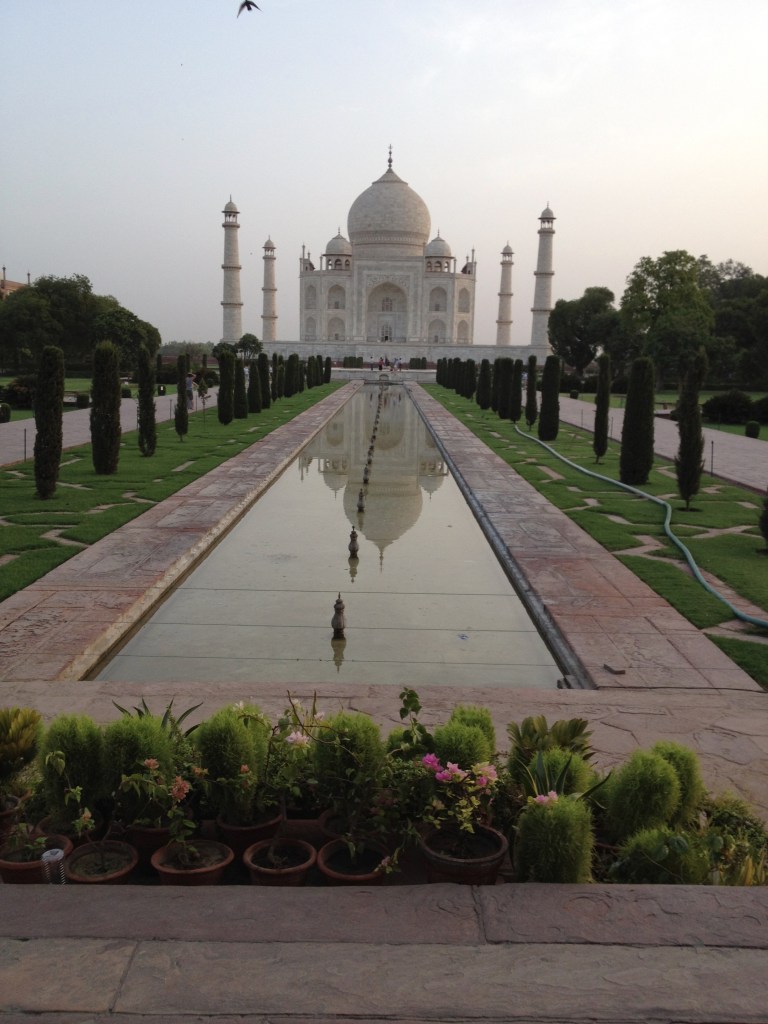
After a restless night – whenever I have an early start for an important event I spend a great deal of the night checking the time and making sure I have set the alarm properly – we got up at 0430 to be at the Taj Mahal at dawn. I cannot begin to describe, or express the emotions I felt, when first I glimpsed the Taj Mahal through the entrance arch. It is simply the most beautiful sight I have ever been fortunate enough to see. The symmetry of the buildings and their place in the gardens (in order to preserve the symmetrical balance a guest house was built as an exact replica of the mosque on the western side), the elegant formality and symmetry of the gardens, the magnificence of the mausoleum itself all strike awe into even the most world weary traveller. For Shah Jehan to devote twenty years and 20000 men in its construction bears poignant testimony to the love that he bore for his wife, Mumtaz.

From the Taj we journeyed to the Red Fort, designed in part by Shah Jehan himself, a Mughal palace, perhaps better described as a fortified city. As such it was built according to a symmetrical pattern, the beauty of which was, as was often the case, vandalised by the British, who removed one of its beautiful colonnades to the Victoria and Albert Museum after the Indian Uprising of 1857, never to be returned. They were also responsible for the deliberately insensitive burial location of John Russell Colvin who died during the peak of the 1857 rebellion.
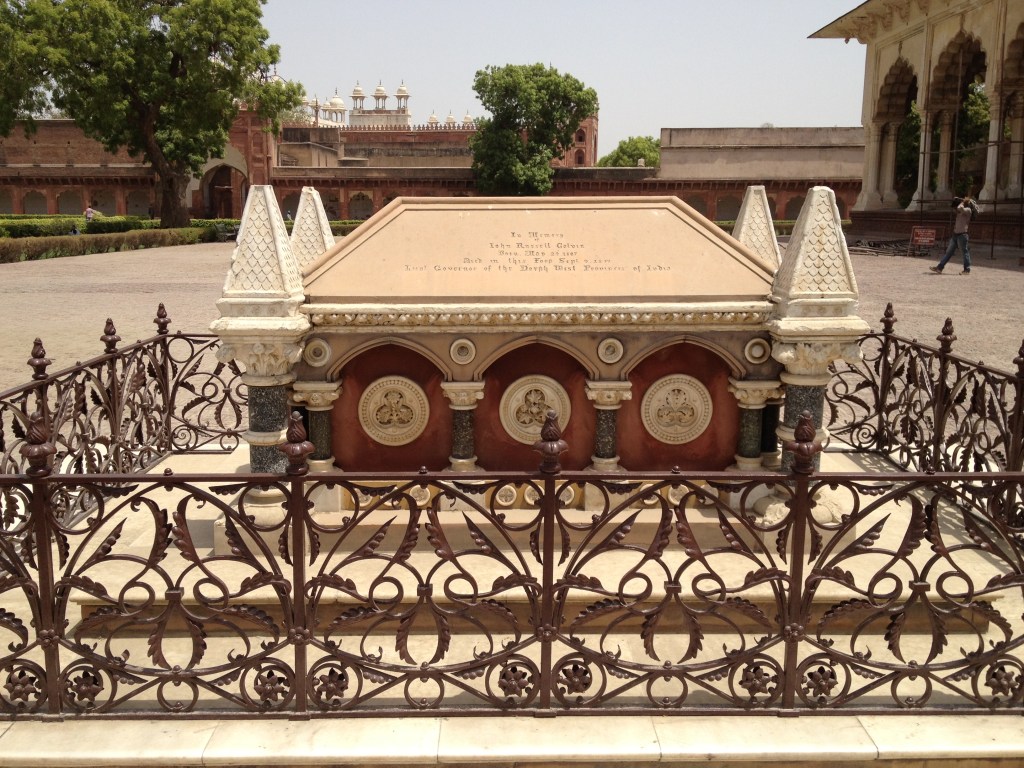
His body could not be carried out of the fort, so he was placed in an ornate and ugly tomb, entirely inappropriate in both style and location, being placed in front of the Diwan-I-Am, the Hall of Public Audience where the emperor sat upon the Peacock Throne to receive petitions from his subjects. Shah Jehan was overthrown by his son, Aurangzeb, and placed under ‘house arrest’ in the Red Fort, where from the ramparts he could gaze down the River Yamuna towards the magnificent resting place of his beloved Mumtaz. When he died, and while Aurangzeb was away in Delhi, his daughter smuggled his body down the river to the Taj Mahal, where he is buried next to his wife, his tomb being the only structure that does not adhere to the original symmetrical design.
5th Day: to Orchha
This morning, after breakfast, we left for Orchha by train from Agra Cantonment Station to Jhansi Junction, from where we were to travel to Orchha by car. The station was not unexpectedly in tumult: beggars, hawkers, travellers, people crossing the line, journeymen offering repairs to baggage and other sundry services, trains packed with people. The Shatabdi Express, while perhaps a little grubby, left Agra punctually and arrived just as punctually at Jhansi.
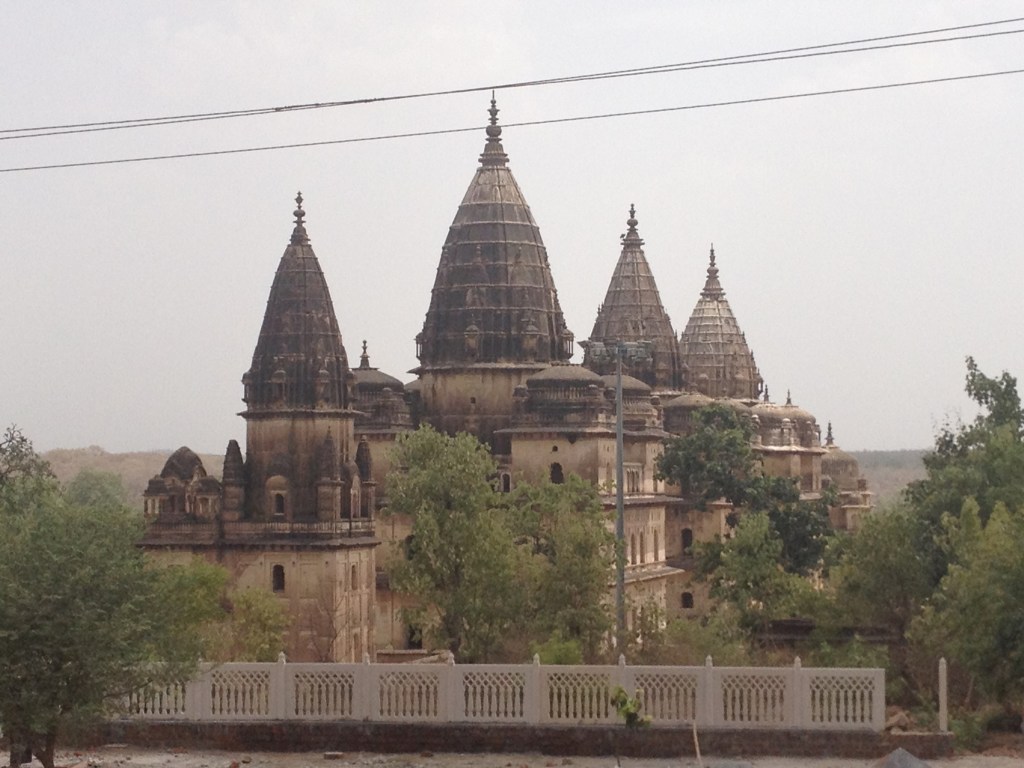
Orchha is a small town, but one liberally provided with beautiful buildings. The Fort, approached across a causeway, and entered via an imposing gateway leads into a large courtyard, flanked by imposing palaces, one of which the Jahangir Mahal, dating from the 16th century, is a particularly fine example of Mughal architecture, each corner of which has a circular tower surmounted by a dome. From the Fort one can look over the Camel Shelter where the King stabled his camels, and from which vantage point one can look out over the ruins of the old city. Dotted about the landscape are a number of chhatris or cenotaphs, many of which are canopied in the same style as those decorating the Diwan-I-Am at Fatehpur Sikri. One such chhatri, perched high above the town, contained some beautiful frescoes and fragments of mosaic. Our examination of these relics was accompanied by a small group of young men, far from importunate, but just staring at what to them must have been the rather strange sight of a couple of sweaty tourists. A young couple asked to have a photograph taken of their daughter with my wife, probably because they were struck by the unusual sight of the vibrant red colour of her hair. Sadly, many of the buildings have fallen foul of the ravages of age, vandalism or the predations of ‘collectors’, there being insufficient funds to preserve or protect them. Nevertheless, it is rare, and moving, to see so many beautiful buildings concentrated in so small a place. There is perhaps a special poignancy in seeing them decaying into the landscape, rather like Ta Prohm in Cambodia.
Our hotel, perhaps in homage to the eponymous Empire, is constructed in Mughal style, with rooms off a quadrangle that surrounds a central courtyard and garden, laid out in symmetrical style, just the place to watch the sunset, gin and tonic in hand. A large group of Italian tourists of a certain age were guests of the hotel and were volubly critical of the staff’s efforts to produce pasta that was acceptably al dente.
That evening, accompanied by our guide, we attended a service at the Rama Hindu temple in the town, which was crammed with joyous, sweating people, chanting, singing, worshipping. After this dramatic experience, we ate at a tiny shopfront café down a short flight of steps, where we were surreptitiously provided with beer in tea cups.
6th Day: to Khajuraho
An early start by car to Khajuraho through a largely unexceptional flat agrarian landscape, before reaching the town which is pleasantly located in a range of hills. Khajuraho is a UNESCO world heritage site famous for its Hindu and Jain temples largely constructed around the end of the 10th century.

The Western Hindu group has some beautiful and largely well-preserved temples, famous for their erotic and explicit sexual sculptures. It was dreadfully hot, but thankfully we were not dragged to local artisan shops as Khajuraho does not appear to have them (neither for that matter does Orchha, at least to my knowledge). The smaller Eastern group contains some small Jain temples, simpler in structure as befits the asceticism of that religion but nonetheless impressive and rather beautiful.
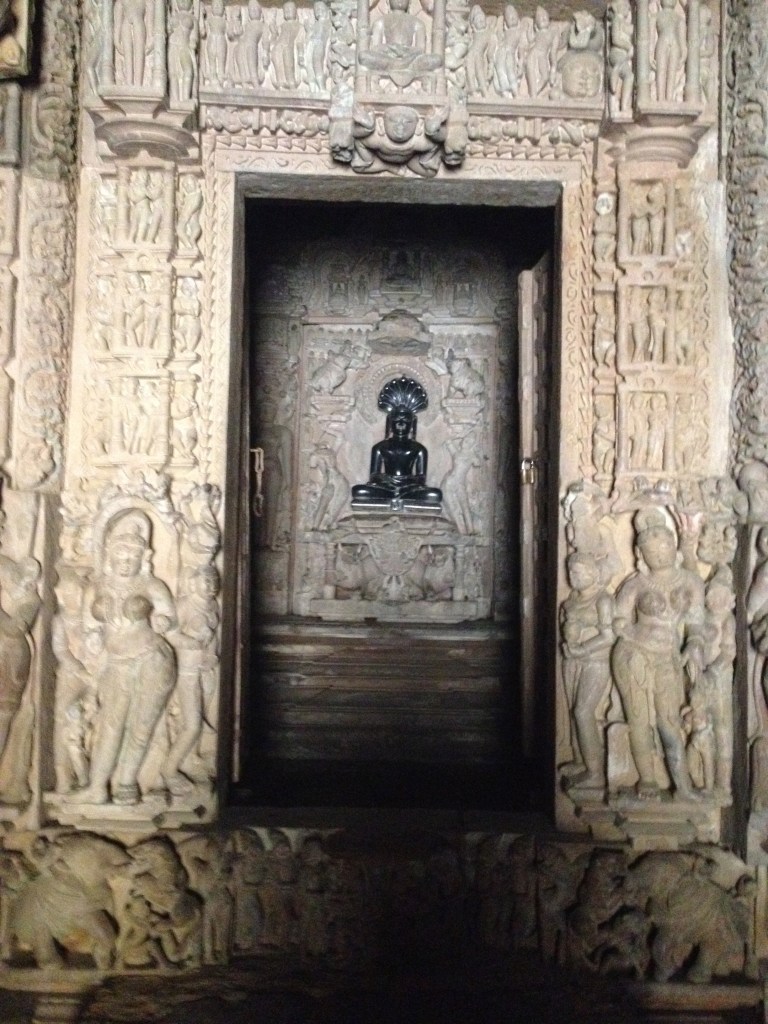
On our way in, and in contrast to the disciplined renouncement of worldly pleasure that characterizes Jainism, we were pestered by trinket sellers offering us miniature working models of the acts of coition depicted in the temples of the Western group.
Our hotel was the only disappointment of the visit. A franchise of a well-known international chain, it was the worst possible combination of international and local with bland, expensive food and drink, grubby décor, malfunctioning air-conditioning and an overall atmosphere of less than genteel decline.
7th Day to Varanasi
Another early beginning to an epic day of travel. We left Khajuraho early by car to drive to the nearest convenient railway station at Satna for our trip to Varanasi. Passing peacocks by the side of the road as we travelled through pleasantly wooded and undulating countryside, we made good time as we approached the less than prepossessing outskirts of the substantial and rather dusty and ugly industrial town of Satna, famous apparently for its concrete works(!). The earliness of our arrival was probably deliberately arranged so we could be ushered into a very grubby café and offered the less than attractive prospect of breakfast.
The Sarnath Express was but a few minutes late, an impressive achievement given that it and traveled nearly 600 km from its point of departure. Our compartment was not unacceptable, consisting of two bunks at either side, convertible to bench seats, and curtained from the corridor. I soon discovered that passengers on the Sarnath Express seem to have less concern for the protocols of personal space, as part of the floor was taken up with a suitcase that we later discovered was the property of someone from another part of the carriage. To make matters worse our seat was occupied by a sleeping woman, covered with what turned out to be our blanket. The conductor soon ejected her, sending her back to the 3rd class carriage. My wife was pleased to discover that unlike the Shatabdi Express, ostensibly a more up-market train, our carriage was furnished with traditional Western style toilets.
The journey began promisingly as we made a stately progress across the North Central Plain, stopping occasionally at some rather remote and desolate places. At 1200 we reached a place called Naini Junction. At 1330 we finally left Naini Junction. As the journey progressed, the word ‘junction’ began to strike something like fear into my heart. I discovered that the Sarnath Express was not considered to ply a particularly important route, so it had to give way to more prestigious trains. The signaling systems on this part of the network were rather primitive, and although other trains passing through this junction were of greater prestige that did not prevent them from being delayed themselves (possibly through having to give way to trains of even greater prestige at other junctions). As a result, junctions can be a source of significant delays, as evidenced by the insouciance of my fellow passengers who took advantage of the delay to stretch their legs and partake of refreshments provided by sellers who swarm on to the platform, doubtless aware of the delays to the Sarnath Express that appeared to be a common occurrence.
Eventually we made glacial progress across the Yamuna river and its confluence with the holy Ganga and pulled into the city of Allahabad, yet another junction, where a new engine was placed at what was now the front of the train, as we were to partially retrace our tracks(!) before plunging off towards Varanasi Cantonment Station. After a brief delay of 45 minutes of so, we moved off. By now I was losing patience (never one of my strengths to honest) and a sense of time, as well as suffering somewhat from the oppressive heat, as the barely adequate air conditioning ceased to operate after longish stops at stations.
So off we lumbered (a word not often used in juxtaposition with express) back across the Yamuna to a small station called Prayag in the hinterlands of Allahabad. There we stopped and remained for some 30 minutes or so. As, together with many of the other passengers, I detrained to stretch my legs, I asked the conductor the reason for this delay, as Prayag was clearly not a junction. He explained that the next stretch of line was only single track and we had to wait for the down train, which, unsurprisingly, was:
- More important than the Sarnath Express; and
- Always late.
I thanked him for this information, and as I turned away from to look up towards the front of the line, I noticed that platform was now suddenly devoid of passengers. Although the signal still appeared to be red, the train began inexorably to move away, leaving me alone on the platform, clad only in T shirt, shorts and sandals, without money or passport. Fortunately, the Sarnath Express does not possess rapid acceleration, and I was able to clamber aboard in reasonably leisurely fashion.
We finally reached Varanasi Cantonment with any further incident of note, apart from a couple of unexplained stops in the middle of nowhere, about three hours or so late after a journey of 111/2 hours. Our first impressions of Varanasi were of a noisy, dirty city, choked with traffic. The station itself was crowded, filthy and full of beggars: on the platforms, on the bridge over the tracks and in the ticket hall.

The hotel is fine, apart from unreliable power supply, which is far from unusual in my experience, provides Kingfisher beer (but see later) and overlooks both the Western ghats and the unpopulated Eastern bank of the Ganga from Assi Ghat.
8th Day Varanasi
Another early start, as we took a rowboat down the Ganges at dawn, making a leisurely progress past row upon row of ghats, some dedicated to laundry–wallahs, other more commonly to the rituals of ablution – washing, swimming, cleaning teeth; others to the performance of religious observance. Further down the river, ghats are dedicated to the conduct of funeral rites. As is well-known, Hindus believe that to be cremated on the banks of this holy river and to have their ashes cast into it at this place is to hasten the achievement of moksha and liberation from the wheel of existence. We passed two cremation ghats, where crowds were gathering around a funeral pyre, and declined our guide’s rather prurient offer to approach more closely out of respect to the ritual being conducted.

Rather than exhaust our boatman by an upstream row against the rather strong current, we disembarked, ascended the vertiginously steep steps of the ghat and plunged into a cramped and crowded Hindu temple, where I got the sense that our presence as gawkers rather than worshippers was not altogether welcomed. We then embarked on a wander through the narrow streets and alleys of the city. I believe Varanasi to be the most confronting of all the cities we visited on this trip: it is as well that we approached it via more agreeable places. The narrow streets and alleys are, almost without exception, filthy and odorous, full of cows (and cowshit), dogs (and dogshit), the occasional rat – both dead and alive – and piles of mouldy, smelly, indescribably unpleasant rubbish: decomposing fruit, food, plastic bags and paper. The thoroughfares are dank and humid, untouched by the breeze that comes across the Ganga from the East. In these streets and alleys, one finds beggars, sadhus, rickshaw-wallahs touting for business and, in stark contrast to this scene, children dressed in 1950’s style English school uniforms being escorted to school by their fathers. We passed street after street of ashrams, small temples, some no bigger than a niche in the wall, occupied by bearded men in dhotis. We came across a deep hole in the ground, with steps leading down to the bottom of it, where men could be seen bathing in a stream fed from the holy river. To this subterranean temple, women wishing to bear children would come at certain propitious times of the year: this brought similar rituals in Italy to mind: the display of the Holy Girdle of the Madonna at Prato cathedral and the legend associated with Piero della Francesca’s Madonna del Parto at Monterchi.
As we returned to our hotel, we came across a young Muslim boy and his companion. They appeared to be begging, but in a rather unusual fashion. They were playing what I assumed to be devotional music through a small and very tinny loudspeaker fixed rather precariously to the handlebars of an ancient and rather rusty bicycle, which was being pushed laboriously along by one of the two boys. A large green sheet, edged in a golden yellow, was tied to the handlebars, while the other end was held by the other boy, dressed rather more formally in white topi and a long robe, or thobe, the sheet thereby forming an impromptu receptacle for the contributions they sought. As he walked backwards through the streets, he maintained an air of rather detached indifference, ignoring the few offerings, including mine, that were received.

After a period of rest, we travelled to Sarnath, where Buddha is said to first preached the Dharma. It consists of a number of ruined stupas, one of which was said to have contained relics of the Buddha himself, as well as several temples, constructed by countries which have significant Buddhist populations such as Sri Lanka, Thailand and Japan. The original stupas, meditation halls and temples were largely destroyed by the Mughals, or in one case inadvertently by a Hindu king who dismantled one temple for its bricks only to discover too late it was said to have contained relics of the Buddha himself. There is very well-maintained museum, contained some building fragments and statuary, including one magnificent intact Buddha in the teaching position.
Returning to our hotel, anticipating a refreshingly cold Kingfisher or two, we were rather dismayed to discover that the hotel was out of beer.
9th Day: to Delhi
An uneventful trip to the Airport and an equally uneventful flight to Delhi for an overnight stop before a very early departure tomorrow morning.
I am looking forward to going home. Travelling in India is exhausting, but our stay has been a transformative one despite constant car horns, power cuts, noise, dust, dirt, poverty and deprivation. That last sentence sounds callous, but that is far from what I mean to say. Every experience of poverty, despair and deprivation I encounter: children begging, old people lying in alleyways, crippled people, makes me feel helpless, and acts as stark reminder of the privileged life I lead. For all that, almost everyone we met was gracious, friendly and helpful and there also have been moments of great beauty: the Taj Mahal; the Red Fort at Agra; Amber Fort; the Pink City of Jaipur; Fatehpur Sikri; the temples at Khajuraho; the beautiful fort, temples, chhatris and the Hindu service in Orchha; Sarnath and dawn breaking over the Ganga as we made our way down river.
10th Day: Home
The hotel kindly provided us with vegetarian salad sandwiches as the time of our departure was before the breakfast hour at the hotel. I had managed to avoid any gastric issues throughout out trip until I foolishly consumed those sandwiches. When I arrived home, I was diagnosed with campylobacteriosis with its symptoms of severe intestinal pain, diarrhoea, sweating, shaking and shivering. Such discomfort was but a small price to pay for one of the experiences of a lifetime.
 Miscellany