One of the great pleasures of a winter visit to Southern England is a long country walk along familiar paths, especially when, after a day of grey, damp cold under lowering skies, the day dawns sunny, bright, cold and crisp under a sky of the palest blue, dotted with cloud and criss-crossed with vapour trails.
This walk begins in woodland. The well-trodden path opens up into a vista of farmland – fields of cabbages, Brussel sprouts, onions and some sort of root vegetable – turnip or radish perhaps. One feature of these sort of country walks is that one is never far from the imprint of man upon the landscape, unlike those in the wilder and more challenging moors hills and uplands of the North and of Scotland. This landscape is tamed, but no less pleasing for that. Its charms are different, and the aspect a mixture of woodland, fields and the built environment.
Recent rain has made the farm track deeply puddled and rather heavy going: the mud glutinous and adhesive. The track takes one past farm outbuildings with their seemingly unorganised clutter of broken pallets, piles of unidentifiable detritus and machinery both new and rustily abandoned. A path away to the left plunges between fallow fields before descending into a sun-flecked coppice of ivy-covered oak, beech and catkin-covered hazel. The coppice is traversed by means of a rather greasy boardwalk that crosses a stream, which is making its way down to the sea. Emerging from the patch of dense woodland takes one on to another path slippery from mud, hedged with hawthorn and strewn with seemingly abandoned badger setts. Here one passes the occasional sturdily shod, warmly dressed walker, usually accompanied by a Labrador intent on examining the interesting olfactory landscape. Brief greetings are exchanged, and the unexpected clemency of the weather favourably remarked upon.
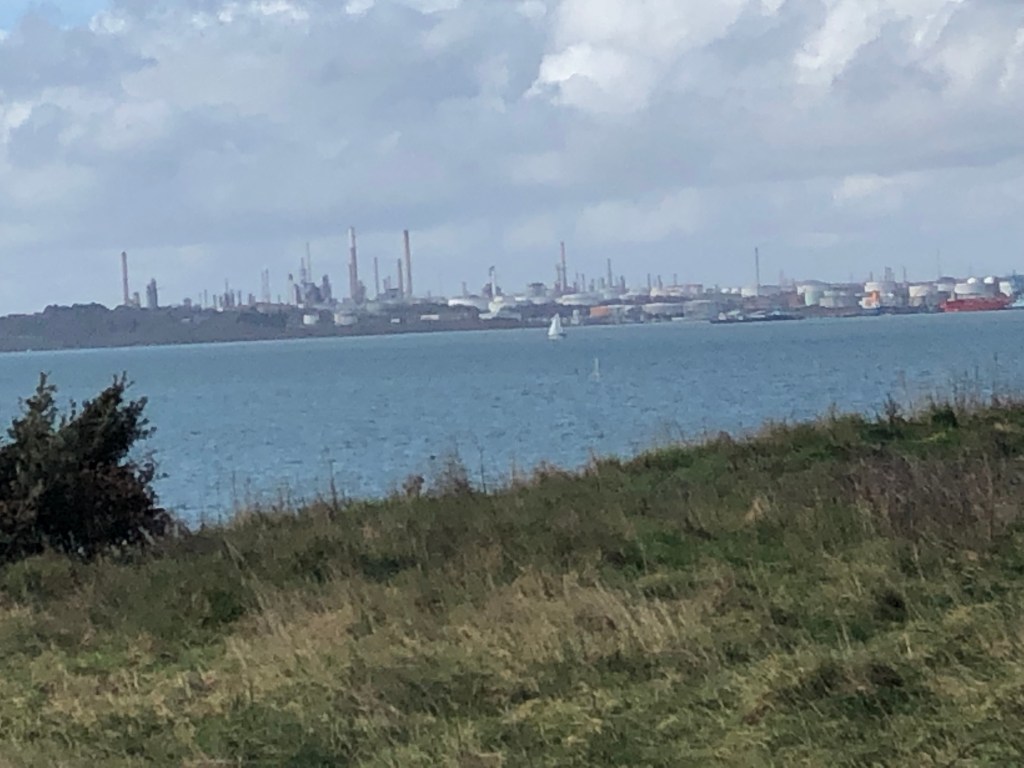
At last the path leads to open fields and a first glimpse of the Solent, busy with ferries, shipping and yachts, with the misty outline of the Isle of Wight beyond. Approaching the crumbling red sandstone clifftop, the hazy outline of Queen Victoria’s favourite retreat, Osborne House, can be made out on the edge of the island. Away to the right the vast bulk of Fawley Power Station and its neighbouring oil refinery, both long shuttered, dominate the entrance to the long arm of Southampton Water. To the east, one or two island forts can be made out, built as part of the extensive defences that protected the important naval seaport of Portsmouth against 19th century fears of French invasion. Now one or two of them are given over to the pursuit of pleasure: spas, hotels and the like. There are other, more recent vestiges of military structures along the clifftop: foundations of gun emplacements and observation posts from World War II. Indeed, this coastline saw the massive military build-up and departure of Allied forces to Normandy in June 1944, with Eisenhower’s headquarters established a few miles to the east in a small village in the hills behind Portsmouth.
The return path from the pebble beach climbs steadily, and muddily – now slick and treacherous underfoot, past clumps of budding daffodils into the rather tenebrous embrace of some overgrown woodland. A deep pool, dotted with ducks who seem to be paying reverent homage to a solitary regal swan, is surprisingly fringed with rhododendron. A possibly Georgian manor house, largely hidden by a high wall and cedars, but glimpsed through an open gate, leads back along a paved track through the well-trodden woodland where the walk began, to the car, and home.
 Miscellany