A view of Eremo Le Celle near Cortona Italy
In the footsteps of Shakespeare
Prologue
Nearly four years ago, I travelled to Italy with my brother who lives in the West Country of England with his family. I have lived outside England in a variety of places for over thirty years and am now happily settled in Australia. The tyranny of distance means that we rarely get to see each other, and our infrequent meetings are taken up with (admittedly pleasurable) family obligations. So, being Italophiles with a shared love of opera and wine, but not necessarily in that order, we decided to decamp ‘a due’ to Northern Italy for a few days. This story is reconstituted from the journal I wrote at the time. It will pay scant regard to consistency of tense and will oscillate inexplicably between Italian and English place names. Our trip took place in early Spring 2016, before the catastrophe of the US Presidential Election: the reason for this aside will become apparent for those dedicated enough to continue with this saga.
Act I, Scene I
Venice
Venice, the location for the Merchant of Venice (obviously!) and Othello, was as cold and damp as I remember from my previous visit, ten years ago at Christmastime. Our hotel was situated on the southern edge of Cannaregio on the Grand Canal near the Ca’ d’Oro. It was of reasonable standard with traditionally complicated and unreliable heating and hot water systems that oscillated wildly and unpredictably between scalding heat and freezing cold. Rather than be (mis)guided by a tourist map, which is my experience often fail to capture the complexity of Venetian topography, we struck out in the general direction of the Piazza San Marco, letting Fortuna[*] be our guide. We managed to stumble across the piazza and the Rialto Bridge and fatigued, ate adequately at a restaurant near our hotel before an earlyish night.
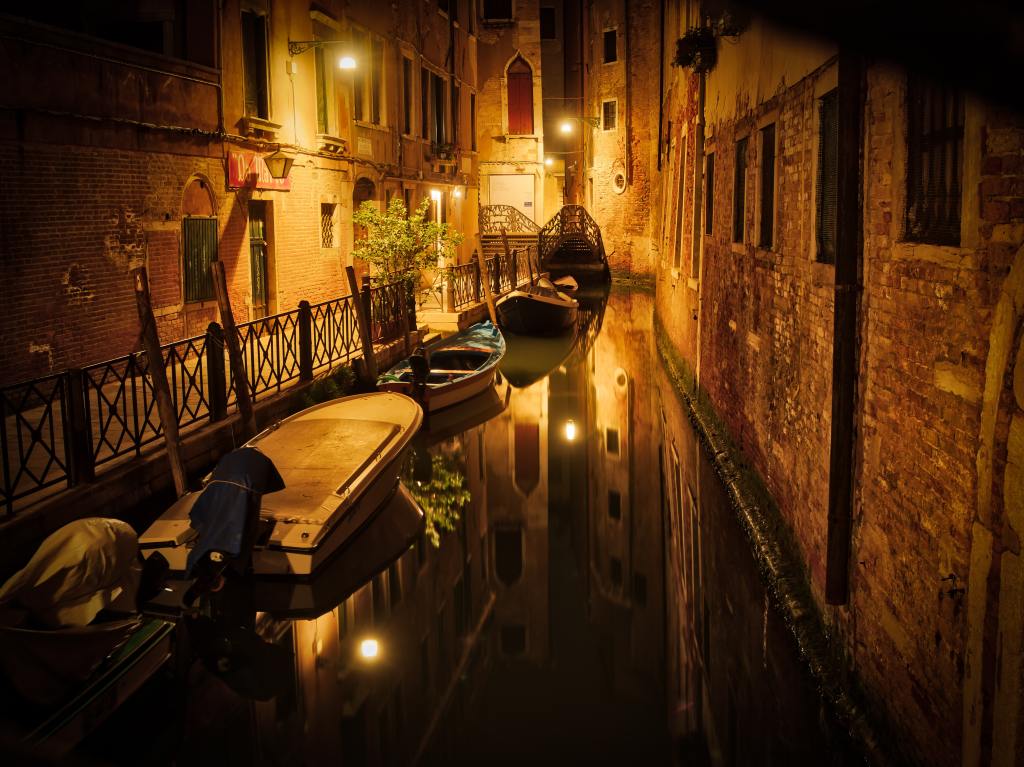
Photo by Alessio Furlan on Unsplash
Venice is as I remember it. Narrow calli, often leading to unexpected dead ends and small bridges across narrow canals. After dark, there is an air of mystery about the place: a whiff of menace. One can imagine nefarious deeds being carried out: theft, conspiracy and murder committed stealthily with the stiletto, secreted within the folds of a hooded cloak.
Our plans to experience the Basilica San Marco and Palazzo Ducale before the threatened onset of heavy rain sadly came to naught. The presence of the Italian Prime Minister and French President, evidenced by a massive warship moored in the basin and large numbers of heavily armed police and soldiers, meant that both of these attractions were closed, presumably so that the Prime Minister could show them off at leisure, and in safety and security. So, we crossed the canal and made our way, in the rain, via the open-air produce market in San Polo, to Santa Maria Gloriosa dei Frari, which houses the remarkable and justly famous Assumption of the Virgin by Titian above the high altar. In a side chapel one finds Giovanni Bellini’s magnificent triptych of the Madonna and Child, flanked by Saints Nicholas, Peter, Benedict and Mark. It is a never-ending source of wonder and pleasure that Italian churches, even the most humble, are full of such masterpieces, open to view for a couple of euros and guarded only by a young priest or aged deacon.
Thoroughly damp, but still wishing to continue our artistic journey, after an espresso in a nearby bar we plunged across Venice to the Guggenheim Museum of Modern Art, home to works by artists including Pollock, Magritte, Picasso, Mondrian, Dali and Miró as well as sculptures by Brancusi, Giacometti and Yoko Ono. It was shut. Fortuna worked against us again. By this time, however, the weather had cleared sufficiently for us to lunch nearby, if rather too well. In an effort to walk off our overly bibulous lunch, we strolled around the sestiere of Dorsoduro under a rather weak sun. It is an altogether quieter district, with a greater feeling of space and a lessening of the claustrophobic constraints felt in the more popular areas of San Marco, San Polo and the southern parts of Cannaregio. Crossing Dorsoduro to its southern edge brings one to open water and views across to the island of Giudecca, little frequented by tourists. Returning across the Canal by the Accademia Bridge, we made a circuitous wander through San Marco back to our hotel. Restored, a ramble led us to pre-dinner drinks, the Venetian tapas known as cicchetti and a reasonable dinner of bruschetta, baccalà and pasta (and wine!) in an osteria hidden away down a quiet calle beside a narrow canal.
Act I, Scene II
Venice (continued)

Photo by Florinel Gorgan on Unsplash
I have experienced the wonder of the Basilica San Marco before, but the wonder remains undimmed. The magnificent Byzantine architecture, surmounted by giant domed cupolas lined with golden mosaics; the vast echoing nave; the rood screen behind which are entombed the relics of Saint Mark, allegedly stolen from Alexandria by a couple of enterprising Venetian merchants; the massive four bronze horses that stand proudly on the balcony, with its views over the piazza and Venice itself: all stay long in the memory. The four horses themselves were plundered from Constantinople during the sack of that city by the Fourth Crusade, which had set off, blessed by Pope Innocent III, to recapture Jerusalem from its Muslim rulers. Instead they were persuaded that attacking the capital of the Christian Orthodox Byzantine Empire was not only less challenging, it would provide richer material reward. Not unsurprisingly, this unprovoked episode of rape, pillage and plunder led to a distinct cooling of the relationship between the Eastern Orthodox and Western Catholic churches.
Visiting the Doge’s Palace was a new and captivating experience. Not only was the art awe-inspiring – the place is bursting with Titian’s, Tintoretto’s and Veronese’s, of which perhaps Tintoretto’s epic Paradiso is the most impressive, crowded as it is with cherubim, seraphim, angels, archangels and all manner of heavenly beings. However, it must be said that it gives the impression that paradise is about as busy as Bourke St on a Saturday afternoon – hardly the place for serene contemplation. The general splendour of the palace with its vast ceremonial rooms and its Venetian Gothic architecture, standing in harmonious contrast with its Byzantine neighbour, gives physical presence to the administrative order and structure that ensured Venice’s stability in an era of war and pestilence.
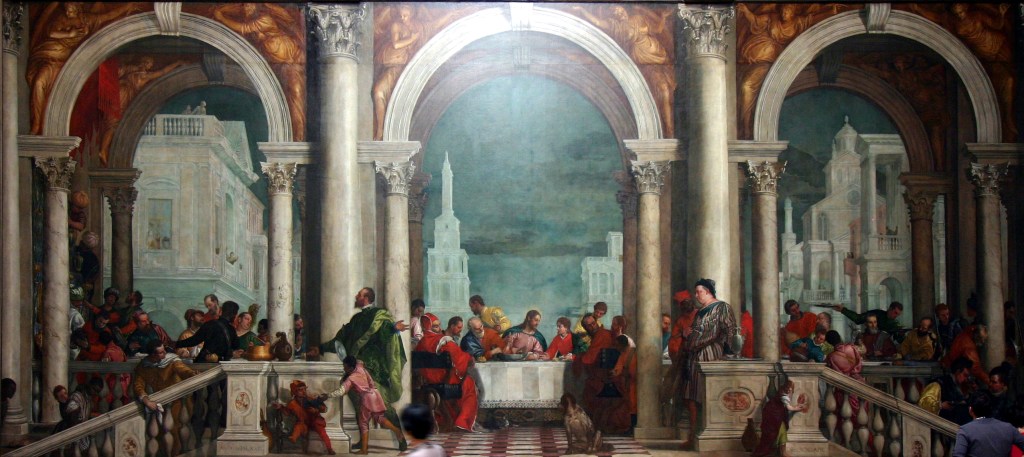
Source:By Paolo Veronese, CC BY-SA 4.0, https://commons.wikimedia.org/w/index.php?curid=51965150
The next day dawned bright, sunny and cold; yet not cold enough to dissuade us from eating al fresco. The sunshine was tempting enough to make the gondolas plump with tourists. A brief visit to the architecturally unusual hexagonal Santa Maria della Salute, perched on a promontory opposite the Piazza San Marco was followed by a more thorough examination of the Accademia. While the internal layout of the museum is not especially well signposted, the art on display is astonishing: an almost overwhelming collection of paintings of the Venetian High Renaissance and Mannerist periods. It houses what is perhaps one of my favourite works of all time: Veronese’s Feast in the House of Levi. It is a massive work of panoramic scope, detail and wit, measuring 550 cm high by 1280 cm wide. It repays detailed, lengthy and repeated scrutiny. Originally commissioned to hang in the refectory of the Basilica di Santa Maria e Paolo, it depicts the Last Supper in what is clearly a Venetian location of considerable revelry and turmoil. It contains a group of German soldiers, drunks, entertainers, dwarfs, and sightseers hanging over balconies to get a better view of the goings-on below. Not surprisingly Veronese was hauled before the Inquisition to explain himself. He must have been as talented with his tongue as he was with a brush, as his only punishment was to repaint the work within three months. Instead, he just changed its name.
On an adjacent wall of the same gallery is his painting of the Crucifixion. Rather than place Christ crucified as the central feature of the painting, He is relegated to the top right of the picture, and Veronese fills the rest with the disordered chaos of the mob, all pushing and shoving to get a better view. In the bottom left hand corner is a soldier, dressed, not in Roman garb, but as a Venetian soldier of the 16th century. My tedious and prolonged pontification to my long-suffering brother on the revolutionary nature of Veronese’s work led an eavesdropping American tourist to ask whether I was an art historian! No, I replied, just an (art) bore.
Act II
Verona
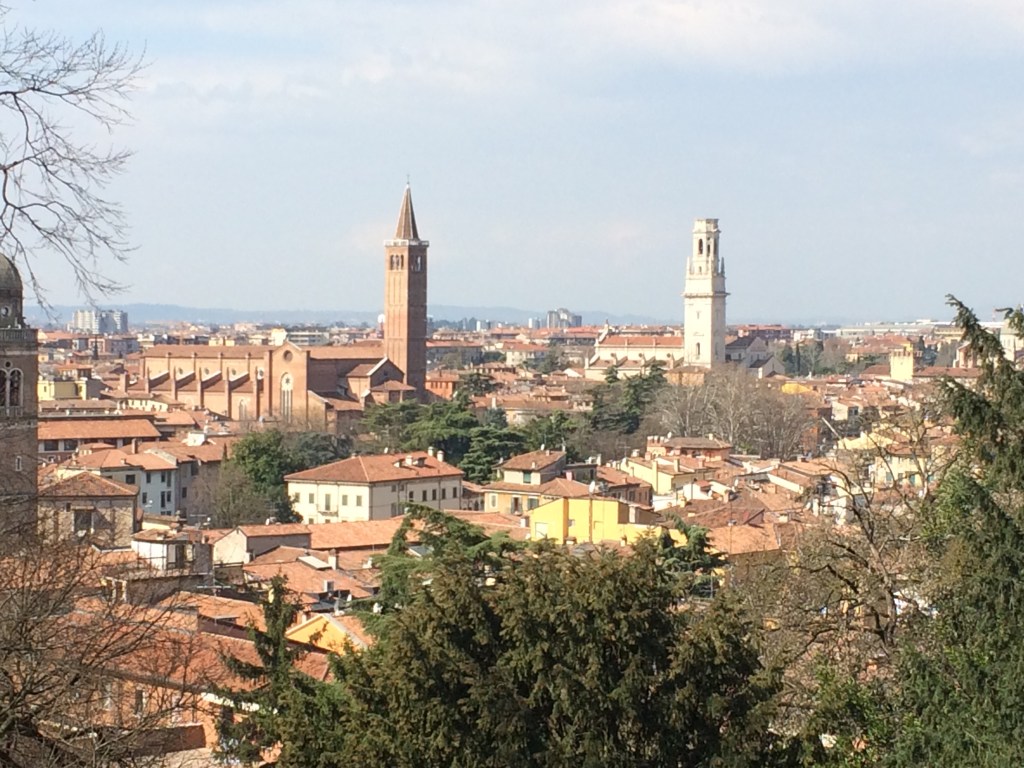
To Verona, by the excellent Frecciarossa high-speed train. Vineyards fringe the route and, away to the right, the snow-capped Dolomites provide a backdrop to the plain. Verona (Romeo and Juliet, Two Gentlemen of Verona) is a pleasant town with a small but interesting historic centre. The noise of traffic that accompanies our walk from the station is somewhat of a shock after the relative silence of Venice. Our B&B, on the edge of the historic centre is rather splendid, with views over the Adige, in some spate, presumably fed by the snow melt from the mountains to the north. After joining the social amble that the Italians call the passeggiata, we discovered what became our regular dining spot, an excellent yet reasonably priced Michelin starred restaurant, Ristorante Maffei, on one side of the busy Piazza delle Erbe. After a reasonable night’s sleep, we found the tombs of the Scaligeri, medieval rulers of the city of Verona. It was the daughter of one the Scaligeri, Regina della Scala, who married Bernabò Visconti of Milan and gave her name to the famous opera house in Milan, La Scala, built on the ruins of the church named in her honour. The most famous of the Scaligeri, Can Grande (Big Dog) whose tomb dominates the family plot, is famous for his patronage of Petrarch and Dante, the latter of whom exiled from Florence lived under Can Grande’s protection. Dante’s statue stands in the middle of the adjacent Piazza dei Signori, looking characteristically grumpy and supercilious.

Fortified by an espresso, we made our way to the ludicrous Casa di Giulietta, predictably crammed with tourists waiting for their turn to be photographed on the Juliet balcony. Sentimental, often mawkish, protestations of love and devotion were scrawled on the passageway leading to the small courtyard. One wonders how may proposals of marriage were made, and accepted, here? Rather more impressive is the Castelvecchio, built by the energetic Can Grande with its curious fish-tail battlements – an architectural feature found throughout Verona. The castle houses a more than adequate museum of statuary and pottery fragments as well as Italian and Flemish art from the 14th to 18th century. A bridge leads across the Adige from the castle, built to provide a means of escape for defenders under attack during the turbulent 14th century from the many enemies of the Scaligeri. It was almost entirely destroyed by the retreating German army in 1945. Despite post-war deprivation, the bridge was rebuilt in 1949, so sympathetically that it was, at least to this untrained eye, impossible to discern the difference between the original 14th century structure and the ‘new’ bridge.
Verona is not just famous for Romeo and Juliet. It is also well-known for its impressive and extremely well-preserved Roman amphitheatre, now given over to opera and other musical entertainments. The city of Verona is to be congratulated for not allowing this public building to become nothing more than a tourist attraction.
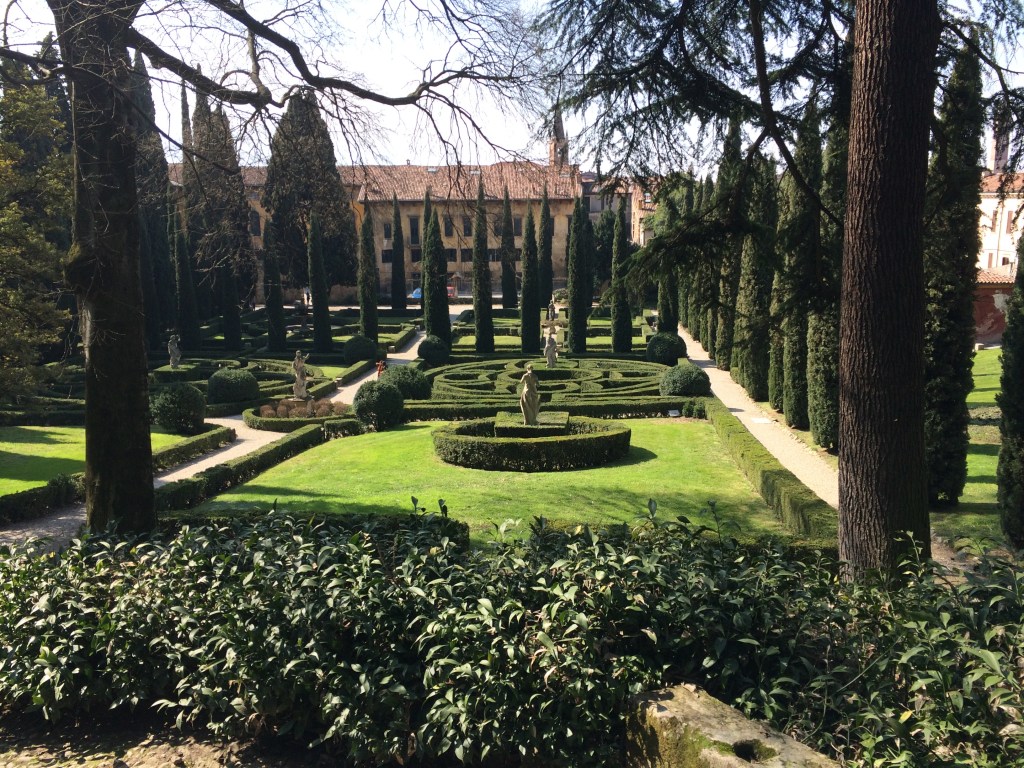
There is yet more to Verona. In HV Morton’s excellent A Traveller in Italy, he mentions the Giardino Giusti located in the grounds of a palazzo of the same name. It is to be found some distance away from the centre of town on the far side of the Adige. To reach it one passes through some residential areas and across some busy roads. However, the journey is well worth it, the garden is well laid out and formal in design, with a less than strenuous climb leading to a belvedere that provides panoramic view over Verona and beyond. Morton mentions an Elizabethan English traveller, Tom Coryat, perhaps the first Englishman to travel abroad for reasons of pleasure rather than pilgrimage, rapine and occasionally both. Coryat visited these gardens and apparently became lost in its maze. Either it has been ruthlessly pruned since his visit or he was of incredibly diminutive stature as it reached no higher than my waist – and I am reasonably vertically challenged. Returning across the river and strolling along its promenade, one comes across the Duomo, with its impressive frescoes and yet another Titian Assumption. The impressive Romanesque façade is rather spoiled in my view by what I assume to be the later addition of a couple of Gothic style windows.
While conducting our evening passeggiata, we came across a very curious game in progress, involving a couple of teams of four inside a netted area, about the size of squash court if not a little longer. One visored team attempts to catch a small bevelled stick shaped to a point at each end that has been propelled towards them rather rapidly by a member of the other team, who does do so by flicking it into the air and attempting to give a good whack with a longish stick. If it is not caught, and it takes considerable skill and courage to do so, then the distance it has travelled is recorded. This is, of course, but a snapshot of the ancient game of s-cianco as it is known in Verona. A little cursory research suggests that it is a game of ancient lineage, having been played in some form or other since before the Christian Era, and widespread through Italy, Greece, Spain and elsewhere. One suspects that in earlier times there was less attention paid to health and safety.
Our final night in Verona took is back once more to our favourite restaurant, where news of imminent departure was greeted with some dismay but celebrated with complimentary pre-prandial prosecco and post-prandial grappa. We were then take on a tour of the Roman wine cellars by the patron, where one of the first ever bottles of the celebrated and expensive local wine Amarone, from 1959, is couched in a small velvet-lined box, housed in a chapel-like alcove and treated with a reverence that is usually reserved for holy relics.
Act III, Scene I
Mantua
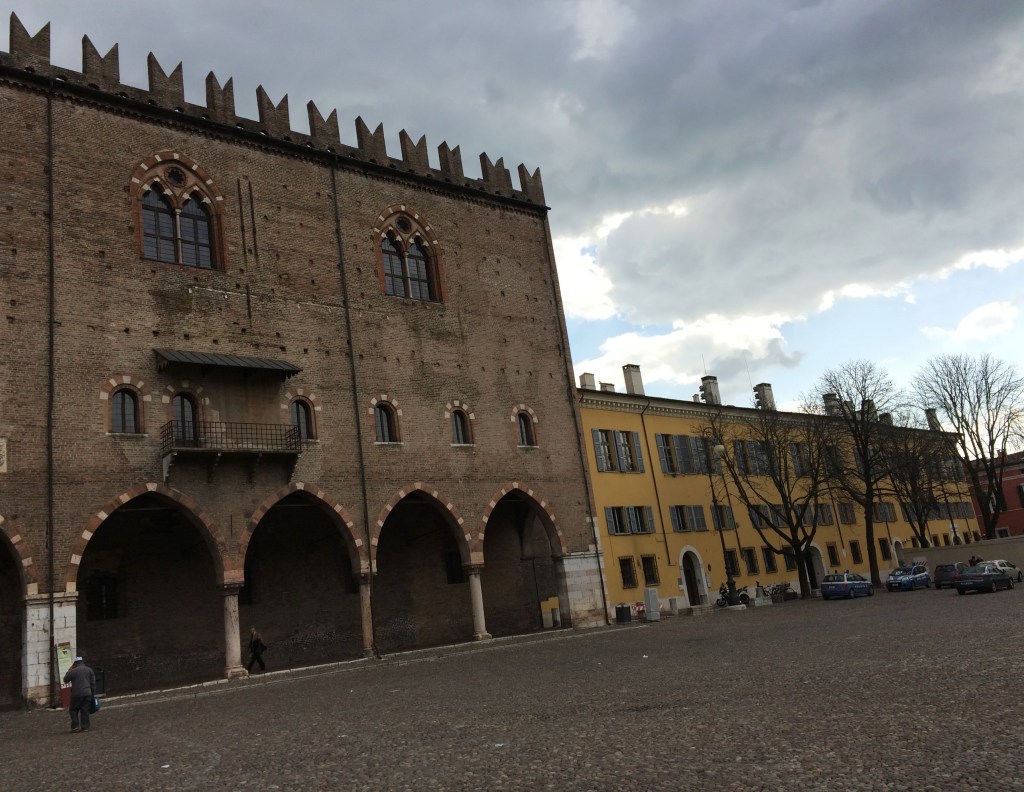
We made a side trip to Mantua (Romeo and Juliet, Love’s Labours Lost), which required a briefish and rather dull train ride away through a flat post-industrial landscape of nondescript small towns and abandoned, derelict factories and warehouses. We had hoped to examine the Palazzo Ducale, ancestral home of the medieval rulers of the city, the Gonzaga, but once again Fortuna was against us as it was shut for the day, although its splendid courtyard and gardens provided a welcome diversion. Mantua itself is an attractive World Heritage city, with a large cobbled piazza leading up to the palazzo, itself approached via a series of colonnaded streets. The town doesn’t just have Shakespearean connections, however, being the location of Verdi’s masterpiece Rigoletto, and its central character the Duke of Mantua, seducer of young women, all round bad egg (and singer of the famous aria Donna è Mobile).
Act III, Scene II
Milan
After our final night in Verona, we departed for Milan (Two Gentlemen of Verona, tenuously) on the efficient, rapid and comfortable Frecciarossa. We passed through the Lombardy plain, the track fringed with farms, vineyards with views of hilltop villages under a blueish-grey sky and a pale white sun. Having settled in to our luxurious and rather expensive accommodation, we made our way down elegant tree-fringed boulevards towards the Duomo, by all accounts the largest Gothic cathedral in Europe. However, our purpose in travelling to Milan was not to examine yet another religious edifice, but to fulfil our long-held dream of seeing opera, any opera, in one of the world’s greatest opera houses, La Scala.
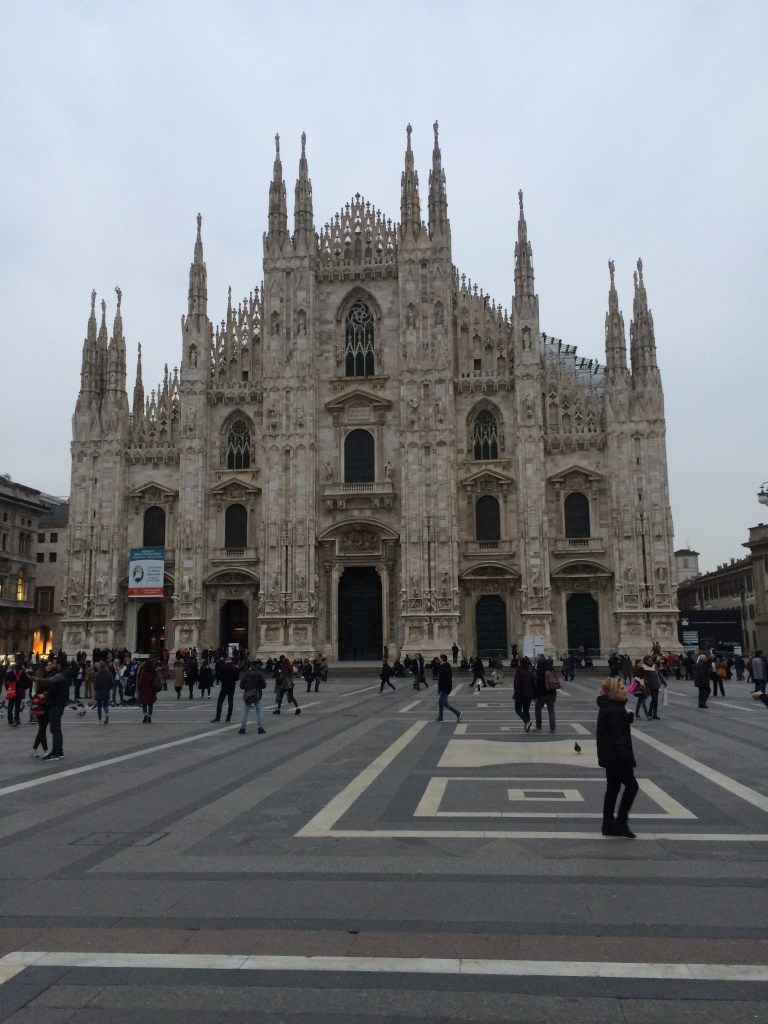
The Duomo is both massive, and massively overwrought, and dominates the adjoining piazza. It took several hundred years to complete, having been started by the Visconti in the 14th century. As a consequence of this protracted period of construction, it underwent several stylistic adjustments, each one of which making the overall effect yet more ornate. The famous Galleria shopping centre, home to some of the more famous names in fashion, lies to the right of the Duomo and leads through to a small piazza which stands in front of the Teatro La Scala.
The theatre itself is rather small, with terraced galleries rising above the more expensive stalls on three sides. We perched on one of the lower galleries, where the seats are so cramped it is easier, and more common, to stand. Such discomfort could in no way detract from our enjoyment of the spectacle. The opera, a less well-known Verdi, I Due Foscari (coincidentally about a Doge of Venice) was beautifully and expressively sung and inventively staged. Even an unwanted conversation with a Midwestern American schoolteacher, whose extensive travels had been spectacularly unsuccessful in broadening her mind, could not temper our happiness. I had demurred, I thought with some subtlety, at her request to express an opinion on the then upcoming US Presidential Election. Undeterred by what I thought was this subtle, yet clear desire not discuss such matters on what was intended to be an evening of pleasurable entertainment, she then proceeded to praise Trump and excoriate what she ludicrously described as the ‘socialist’ Obama, both Clintons, Hispanic people, migrants, Muslims and just about anybody who wasn’t a white conservative American. At this point, my tact deserted me (a not uncommon occurrence it must be admitted), and both my brother and I made our feelings known about Trump in particular (demagogue, racist and misogynist may have been words we used) and her bigotry in general. Of course, it made no difference at all. She remained convinced: a true believer (and teacher of the next generation of Americans).
After that exchange, we needed a drink. So, on our gentle stroll back to our lodgings through a light drizzle, we paused in a bar for a restorative grappa or two. After a good night’s sleep, we returned, uneventfully to Venice and boarded our flight back to England.
[Players exeunt, stage left]
THE END
[*] Fortuna was the Roman goddess of fortune, and represents life’s capriciousness: so, it can be good, bad or somewhere in between.
 Miscellany